

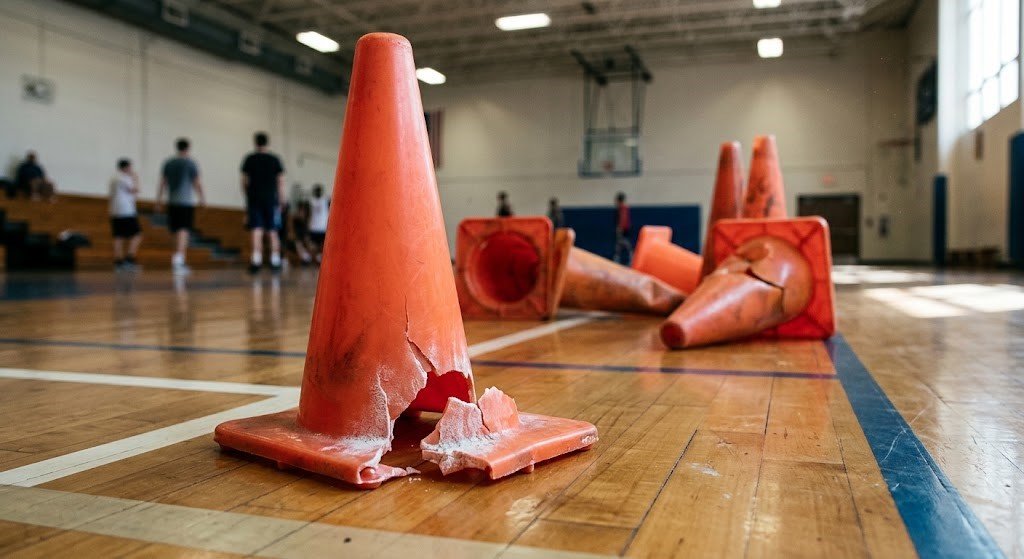
New cones arrive in August. By October, half of them are split. Bases separate from walls, tops cave inward, and the bright orange has gone chalky white.
PE teachers blame the kids. The kids are not the problem. Cheap cones were never made to survive sunlight and gym floors.
Thirty Kids Step on Every Cone Daily
Backyard cones get kicked on weekends. School cones get stepped on by thirty pairs of shoes, five days a week, across six class periods. That works out to roughly nine hundred impacts a day on the same thin wall.
Manufacturers call this institutional use. Home gear gets used gently on weekends and replaced out of boredom, while school gear absorbs hundreds of impacts a day and gets replaced only when it breaks. The gap between those two lives is where cheap cones die.
Flexible Plastic Bends Where Rigid Plastic Breaks
Cones fail at the material level. Rigid polypropylene snaps under a shoe. Low-density polyethylene, LDPE, flexes and returns. The difference shows up during the first week of relay drills.
Districts that buy heavy-duty agility cones for schools from PullBuoy get thicker walls and flexible resin that springs back after a full class period of stomping.
Before ordering, read the spec sheet like a mechanic:
- Material: LDPE or flexible PVC beats rigid plastic every time.
- Wall thickness: press the wall between two fingers; it should push back.
- UV inhibitors: look for the words on the listing, since bright color alone proves nothing.
- Stated warranty: a company that guarantees years trusts its own plastic.
PullBuoy builds its SlotCone line around slotted sides that give under-weight instead of cracking. The slots are a patented detail, and they exist because flat walls take the full force of every step.
Sunlight Ages a Cone Before September Ends
Ultraviolet light breaks the long molecular chains in plastic. The surface turns chalky, then brittle, then shatters under a normal step. Cones left in an outdoor bin age in dog years. Heat makes it worse.
UV inhibitors mixed into the resin slow the decay. Cheap cones skip them to hit a price point. A cone stored in sunlight without inhibitors can go brittle in a single summer.
Cold Mornings Turn Thin Cones Into Glass
Plastic stiffens as temperature drops. Cold makes everything brittle. A cone that flexes in September turns rigid in November, and the first hard kick on a frosty field splits it clean.
Fall sports run straight through that window. Coaches know this. Soccer practice in 40-degree weather is normal across most states, and that is exactly when thin cones give up.
Winter practice tests every cone on the rack. PullBuoy builds its line for daily school use, and thin plastic still fails first in the cold months.
Storage Habits Decide the Second Season
Stacked cones crush each other. A tall stack in a shed puts the whole weight of the pile on the bottom cones. They warp into ovals that never sit flat again.
Damp storage adds mildew and smell, and a cone that stinks stays in the shed even when class needs it. Direct sun through a shed window keeps the UV damage going all summer. Cones tossed loose in a ventilated bin outlast cones baked in a tight stack.
Orders from PullBuoy ship free over $49, so a teacher replacing a class set does not need a purchase order battle to do it. Small reorders beat emergency reorders.
Count Replacements Before Counting the Price
$0.99 disc cones look like a bargain. Replace a 50-cone set twice a year, which most schools do after fall and spring seasons chew through the first batch, and the bargain costs $100 annually. A $7.50 heavy-duty cone lasting five years means 50 cones cost $375 once, which works out to $75 a year.
Median PE budgets sit under $800 a year, so every repeat purchase eats money meant for new activities. Buying once frees the rest of the budget for actual teaching. That is the whole argument.
PullBuoy’s adapted-PE options stretch the same budget further because one flexible set serves general and inclusive classes alike. Fewer separate orders, fewer cracked replacements.
Buy Once and Coach Without Interruptions
Next August, the order can look different. Teachers who check materials and replacement math first spend September coaching. Not reordering. The background on how physical education programs run in schools worldwide shows why reliable equipment matters for daily instruction.
Cones are the smallest line item in the gym and the most replaced. Fix the smallest problem first, and the rest of the equipment list gets easier.