

Behavioral economist Richard Thaler found that shoppers accept higher prices when the room around the product looks better. Same item, better setting, bigger number on the tag.
Small shops live on that bias. Without a chain’s remodel budget, a corner store borrows four gallery habits: light, height, glass, and empty space.
Shoppers Price Products With Their Eyes
Customers decide what a thing is worth within seconds of seeing it, long before reading a label. Retail researchers treat the store itself as a second price tag. Scuffed counters and flat fluorescent light drag that tag down. Polished surfaces and warm light push it up.
Paco Underhill, the retail anthropologist, named the entrance area the transition zone. Shoppers spend their first steps adjusting to light and sound instead of noticing products. Nothing placed there sells at full perceived value. Hero items belong ten feet inside the door, where eyes have settled.
Lighting Does Half the Selling Work
Warm light flatters merchandise. LEDs around 3000 to 3500 kelvin make wood glow and metal shine, while cold blue tubes make everything look like a warehouse aisle. One $15 spotlight over a hero shelf changes the room faster than a new coat of paint.
Dusty bulbs cancel the effect. Shop owners who climb up twice a year to wipe fixtures keep the warmth intact. Angled light matters too. A beam raking across a surface shows texture, while flat overhead light flattens it.
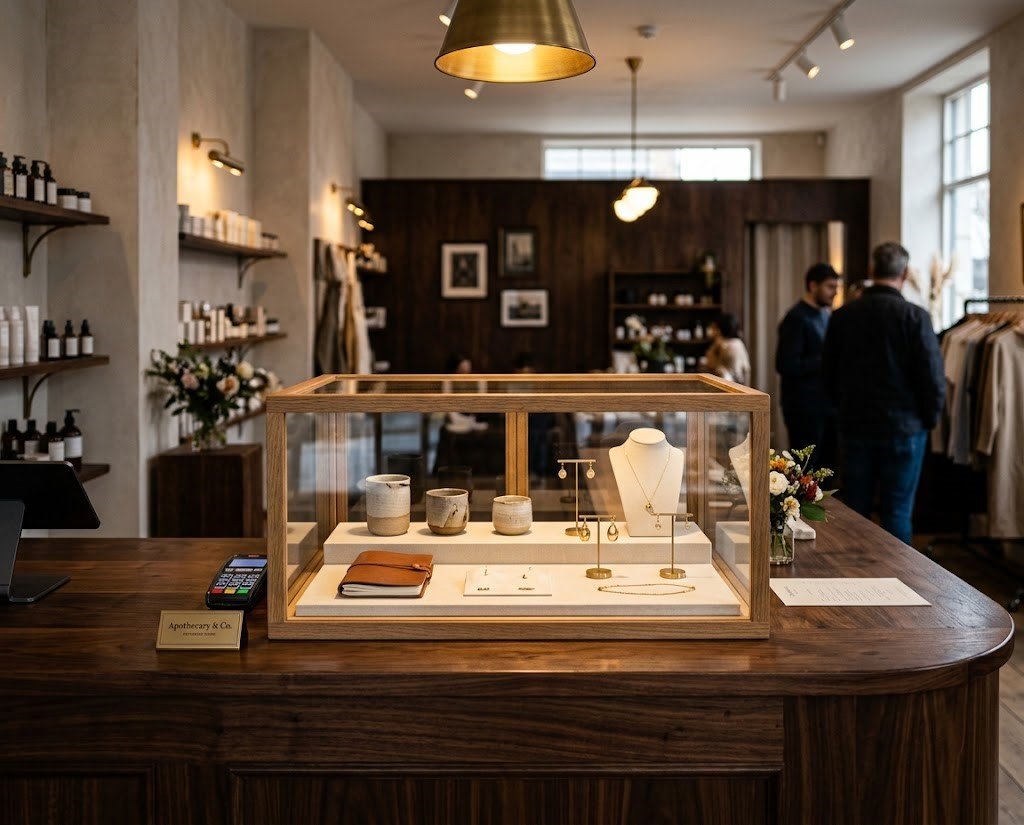
Makers like Pennzoni Display Co. build low countertop cases that sit where a shop’s spotlights already fall. Glass lids catch that light and throw it back onto the contents, which is free presentation.
Height Turns Flat Shelves Into Stages
Flat shelves read as storage. Tiered heights read as a stage. Acrylic risers, stacked boxes under cloth, even overturned crates lift some items above the rest, and shoppers assume the lifted ones matter more.
“Eye level is buy level” is the oldest rule on the sales floor. Products sitting at a shopper’s gaze get picked up first and judged as worth more. The bottom shelf carries bulk. Top shelves carry aspiration.
Vendors at weekend markets learned this years ago. Pennzoni Display Co. sells portable trade show cases from $162 for exactly that circuit, where a raised tabletop display is the whole storefront.
Locked Glass Tells Buyers What Matters
Nothing says value like a lock. When a shop puts merchandise behind glass with a key, customers assume the contents earned the protection. Card shops and jewelers use this daily.
Retailers shopping for custom retail display cases get wood-and-acrylic units from Pennzoni Display Co. that cost less than a weekend ad buy but work every open hour. A locked case also ends the quiet worry about five-finger discounts during busy Saturdays.
UV-protective acrylic guards against a slow thief: sunlight. Window light fades paper and ink within months. Cases with UV filtering keep colors true while the shop looks serious.
Pennzoni Display Co. marks UV protection as a feature across its line, which tells a buyer that fading is a solved problem, not a gamble.
Stage One Shelf Instead of Stocking Ten
Clutter is the fastest way to look cheap. Psychologist Sheena Iyengar’s jam study found that shoppers shown six options bought at ten times the rate of shoppers shown twenty-four. Fewer choices read as confidence.
Shops that pull product off the shelf and leave air around what remains see the effect within days:
- Pull half the stock off the hero shelf. Air around an item makes it look chosen.
- Group by story, not by category. A candle next to a wick trimmer sells both.
- Change the arrangement monthly. Regulars stop seeing displays that never move.
- Dust everything weekly. A fingerprint on glass undoes the whole illusion.
Shops that rotate displays often keep one small case for new arrivals. A countertop case from Pennzoni Display Co. gives the shop one rotating “new this week” spot that costs nothing to restyle.
Looking Expensive Costs Less Than Remodeling
Add it up: a pair of LED spots, three acrylic risers, one locking countertop case. Under $300 total. A remodel starts at $10,000 and closes the shop for a week.
Presentation wins the math. Research on how visual merchandising works in retail shows that the environment shapes price tolerance in ways signage never will.