


The American landscape of professional success is shifting. While the tech boom defined the early 2010s, the mid-2020s belong to a different titan: Healthcare Management. As the U.S. healthcare system undergoes a radical transformation—driven by an aging population, digital integration, and shifting policy—the demand for skilled leaders who can navigate both medicine and business has reached a fever pitch.
Today, pursuing a degree in healthcare management isn’t just about entering a stable field; it is about obtaining a “power degree” that offers unparalleled ROI, leadership opportunities, and the chance to influence the well-being of millions.
The Convergence of Business and Medicine
For decades, hospitals were led primarily by clinicians. However, the modern U.S. healthcare environment is far too complex for medical expertise alone. We are seeing a convergence where financial literacy, data analytics, and organizational strategy are just as vital as patient care protocols.
The Bureau of Labor Statistics (BLS) projects that employment for medical and health services managers will grow by 28% from 2022 to 2032, a rate significantly faster than the average for all occupations. This translates to roughly 54,700 openings each year. For students currently navigating these rigorous academic tracks, the pressure to master complex regulatory frameworks and financial models can be overwhelming. Many find that securing professional healthcare assignment help is a strategic move to ensure they grasp the high-level concepts required for top-tier administrative roles without falling behind in their GPA.
Data-Driven Value: Why the ROI is Unmatched
When we talk about a “Power Degree,” we are talking about outcomes. According to recent data, the median annual wage for medical and health services managers in the US was $110,680 in 2023. The top 10% of earners—often those with specialized Master’s degrees (MHA or MBA in Healthcare)—exceeded $216,000.
| Sector | Median Annual Salary (USD) |
| Government | $121,160 |
| Hospitals (State, Local, Private) | $121,080 |
| Outpatient Care Centers | $103,130 |
| Nursing & Residential Care | $92,260 |
Beyond the salary, the degree offers versatility. Graduates are no longer confined to hospital hallways; they are being recruited by insurance giants, health-tech startups, and federal policy institutes.
The path to a healthcare management degree is intensive. Students must demonstrate proficiency in:
- Health Law and Ethics: Navigating HIPAA and evolving reproductive and telehealth laws.
- Financial Management: Managing multi-million dollar budgets and insurance reimbursements.
- Strategic Planning: Implementing AI and EHR (Electronic Health Records) systems.
Given the high stakes, academic integrity is paramount. In an era where AI-generated content is under scrutiny, students must ensure their research is original and properly cited. Utilizing a reliable assignment plagiarism checker is a standard practice for top-performing students who want to guarantee their case studies and policy papers meet the rigorous E-E-A-T standards of modern American universities.
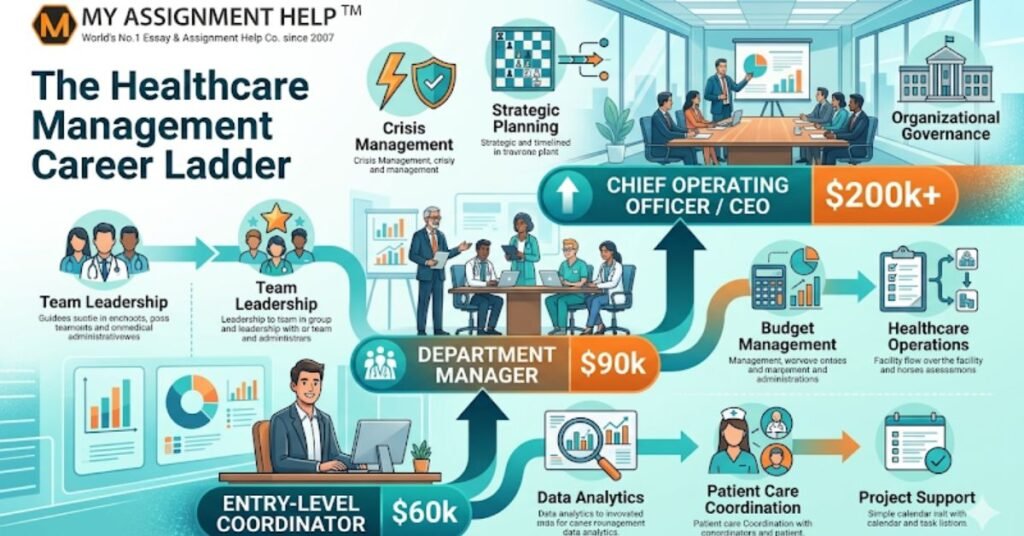
The “Silver Tsunami”: A Demographic Driver
The “Silver Tsunami”—the aging of the Baby Boomer generation—is the primary engine behind this degree’s power. By 2030, all Baby Boomers will be over age 65. This demographic shift requires a massive expansion of nursing homes, home health services, and chronic disease management facilities.
The US healthcare system is pivoting from “volume-based care” to “value-based care.” This means managers are now incentivized to keep patients healthy rather than simply filling hospital beds. This shift requires a deep understanding of population health management, a core pillar of the healthcare management curriculum.
Strategic Interlinking and E-E-A-T
In the eyes of Google, Expertise, Authoritativeness, and Trustworthiness (E-E-A-T) are the benchmarks for quality content. This applies to both the professionals working in the field and the students writing about it. When drafting a thesis on healthcare policy or an assignment on hospital logistics, referencing peer-reviewed journals and current federal data is non-negotiable.
Key Takeaways
- Massive Growth: A 28% growth rate makes it one of the most stable career paths in the US.
- High Salary Ceiling: Potential to earn well over $200,000 in executive roles.
- Versatility: Opportunities span tech, government, private practice, and non-profits.
- Technological Integration: The degree focuses heavily on the future of AI and telehealth.
Frequently Asked Questions (FAQ)
1. Is a Master’s degree required for Healthcare Management?
While entry-level roles are available with a Bachelor’s, a Master of Health Administration (MHA) or an MBA in Healthcare Management is typically required for senior executive positions and higher salary brackets.
2. What is the difference between Healthcare Administration and Healthcare Management?
Administration often focuses on the day-to-day operations and “staff” side, while Management is broader, focusing on the strategic, financial, and organizational “big picture” of the facility.
3. Is this degree immune to economic downturns?
Healthcare is considered “recession-proof.” Even during economic shifts, the demand for medical services and efficient management remains constant.
4. Can I work in Tech with this degree?
Absolutely. Many graduates work for “Health Tech” companies, developing and managing the implementation of medical software and data analytics tools.
Author Bio: Angelika
Senior Academic Consultant & Content Strategist
Angelika is a seasoned educator with over a decade of experience in academic consulting, specifically focusing on the US healthcare education sector. As a lead strategist at MyAssignmentHelp, she specializes in bridging the gap between complex medical theory and practical management application. Her work emphasizes the importance of academic integrity and the development of E-E-A-T compliant research for aspiring health professionals.
References
- U.S. Bureau of Labor Statistics. (2023). Occupational Outlook Handbook: Medical and Health Services Managers.
- Centers for Medicare & Medicaid Services (CMS). (2024). National Health Expenditure Data.
- Journal of Health Administration Education. (2025). Trends in Healthcare Leadership Curriculum.
- American College of Healthcare Executives (ACHE). (2026). Annual Report on Healthcare Labor Trends.