

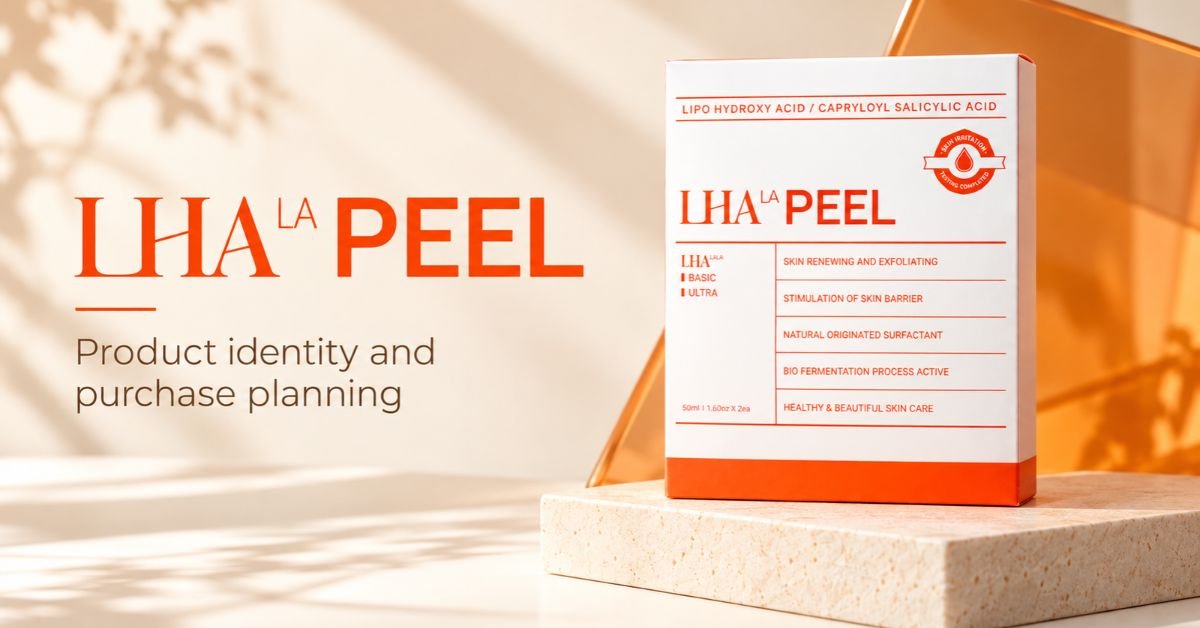
A complexion can look tired even when it does not have deep wrinkles. Uneven surface texture, visible flakes and excess shine interrupt the way light reflects from the skin. That is the space in which Lhala Peel attracts attention: professional exfoliation aimed at a smoother, fresher looking surface, with a formula built around LHA and accompanying skincare ingredients.
Understanding Lhala Peel starts with that surface focus. It is a professional peel system, rather than a volumizing product. The useful questions are what LHA does, how the surrounding formula contributes, and what people mean when they describe a glass skin finish. These distinctions make its appeal much easier to understand than a long list of technical claims.
What makes the Lhala formula distinctive
LHALALA identifies LHA, H2sol, a lipid complex and INCUBE 504 in its current product presentation. The professional format comprises Basic and Ultra, each in a 50 mL bottle. Together, these details describe a formulated system with two named components, rather than a generic bottle of salicylic acid. The accompanying cleanser and mask belong to the wider range and should not be confused with the peel itself. [1]
LHA is short for lipohydroxy acid. Its ingredient name is capryloyl salicylic acid, a derivative of salicylic acid with a fatty side chain. That structural difference increases its affinity for lipids and influences how it interacts with the outer skin layers. Research on LHA has examined desquamation, the shedding of surface cells, and changes in follicular plugging. These properties explain why the ingredient appears in products concerned with texture and congestion. [2,3]
The surrounding formula matters because an exfoliant is more than its headline acid. The vehicle affects spreading and contact with the skin; moisturizing components influence how the surface feels. A formula designed around several of these functions can have a different cosmetic character from a simple acid solution, even when both are described as peels.
How exfoliation changes the appearance of texture
The outermost skin layer consists of flattened cells held within a lipid environment. Normal shedding keeps this surface relatively even. When cells accumulate unevenly, the result can include rough patches, a dull appearance and makeup that catches on dry areas. Exfoliation changes this outer surface; it does not need to remove a visibly thick sheet of skin to be meaningful.
This explains an important difference between smoothness and volume. A smoother surface can reflect light more evenly and make very fine texture look less obvious. It cannot replace the physical support lost from deeper facial tissues. Someone describing a fresher complexion may therefore be noticing a surface change, while someone seeking fuller contours is describing a different goal.
LHA research gives a rationale for this surface emphasis. Published work has explored relatively targeted exfoliation and effects on comedonal material. However, the ingredient studies used their own formulations. They explain why LHA is interesting; they do not establish a fixed percentage improvement for every finished product containing it. [2,3]
LHA compared with familiar exfoliating ingredients
Acid names are often treated as a ranking, with the newest ingredient assumed to be strongest or best. A more useful comparison looks at their chemistry and the type of formulation in which they appear. Glycolic acid, lactic acid, salicylic acid and LHA overlap in exfoliating purpose, but they are not interchangeable ingredients.
| Ingredient | Distinguishing feature | Common cosmetic focus |
| Glycolic acid | Small alpha hydroxy acid | Surface texture and photoaged appearance |
| Lactic acid | Alpha hydroxy acid with moisturizing relevance | Texture and dry looking skin |
| Salicylic acid | Lipid soluble beta hydroxy acid | Oily skin and follicular congestion |
| LHA | Lipophilic salicylic acid derivative | Controlled surface exfoliation and congestion |
These are ingredient level distinctions, not a ranking of finished peels. Concentration, pH, vehicle and the overall formulation all contribute to performance. Comparing two products solely by acid percentage misses much of what determines their behavior. A lower number on one ingredient is not automatically weaker than a higher number on another. [2,3]
Research on combined salicylic acid and LHA skincare has also examined acne related appearance. A study of a serum and mask illustrates how exfoliating ingredients can be evaluated within a complete regimen. Because it investigated different finished products, its findings belong to those products, while providing useful context for the broader formulation approach. [4]
What the glass skin description actually means
Glass skin is a visual description, not a single biological endpoint. People usually mean a surface that looks smooth, hydrated and evenly reflective. Several independent features contribute: the amount of visible flaking, the appearance of pores, uneven pigment, oil distribution and lighting. No one ingredient controls all of them.
Exfoliation can contribute by reducing surface roughness. Moisturizing care contributes by improving the appearance and feel of dryness. These functions fit together because a freshly refined surface still needs comfortable everyday care. The desired finish is generally suppleness and even reflection, rather than a tight, stripped sensation.
This distinction is especially useful when comparing photographs. Strong frontal light, fresh moisturizer and a different camera angle can make the same skin look dramatically more reflective. A meaningful assessment compares texture and comfort under similar conditions, including how the skin looks without a layer of makeup or freshly applied product.
For someone interested in Lhala, a concrete goal might be less visible surface roughness or a smoother makeup finish. Those goals are easier to describe and evaluate than an undefined promise of complete rejuvenation. They also keep the product connected to an everyday concern the reader actually recognizes.
Basic and Ultra within a professional skincare system
The two bottle names are a recognizable part of Lhala’s identity. Their value to the reader is understanding that the brand presents a coordinated professional system. Basic and Ultra are not two unrelated products competing for the same place on a bathroom shelf. The format also separates the peel from supporting products such as cleansing foam and finishing masks. [1]
A professional peel consultation can therefore focus on the desired surface change and how it fits the person’s existing skincare. Frequent exfoliating products, an uncomfortable skin barrier and a recent procedure all change that discussion. Choosing the appropriate treatment belongs to the practitioner, while the reader’s useful contribution is a clear description of current skin concerns and routine. [5]
Understanding Lhala Peel price
A lhala peel price can refer to a product set or to a clinic service. These are different purchases. The product price concerns the supplied bottles; a service price also reflects the appointment, professional assessment and other included care. A low product price and a higher service price can therefore both be accurate.
For a practice comparing supply options, the useful commercial details are concise: which set is included, the number of sets and the delivered cost. For a client comparing appointments, the more relevant question is what the service includes and whether its surface focused aim matches the concern.
Frequently asked questions
Is Lhala Peel a filler?
No. Its central role is professional exfoliation and surface skincare. The word “fill” sometimes appears in brand language, but that does not make the peel equivalent to a dermal filler that physically adds volume. A smoother looking complexion and a fuller facial contour are different outcomes.
Is LHA the same as salicylic acid?
LHA is a derivative of salicylic acid, identified on ingredient lists as capryloyl salicylic acid. Its fatty side chain changes its chemical behavior. The relationship explains their overlapping interest in oily or congested skin, but the two ingredients should not be treated as identical formulations.
Does visible peeling show that it worked?
Visible flaking is not a universal measure of exfoliation. Surface changes may be subtle. The more relevant observations are the specific concerns discussed beforehand, such as roughness or an uneven looking finish, together with how comfortable the skin feels afterward. More dramatic shedding is not automatically a better cosmetic result.
Can it permanently remove pores?
Pores are normal anatomical openings. Their appearance can change with congestion, surface oil, surrounding texture and light. A clearer or smoother surface may make them less noticeable, but “poreless” is a visual shorthand, not literal removal of the openings or a permanent anatomical change.
Why does moisturizing care still matter?
Exfoliation and moisturization serve different functions. Refining the surface does not eliminate the skin’s need for water retention and a comfortable barrier. A simple routine that suits the individual helps maintain a smooth looking finish without assuming that every concern requires another exfoliating step.
How should someone compare it with another peel?
Start with the intended cosmetic goal, the complete formulation and the professional service offered. An acid name or a generation number alone cannot describe the whole experience. Lhala’s LHA based system is a useful point of distinction, while the best comparison remains specific to the skin concern.
Explore the product behind the surface finish
Lhala combines LHA with a coordinated professional peel system for surface focused skincare. Readers considering professional exfoliation can explore the range through ELE Global and compare the available set with their product needs. Keep the decision centered on the formula, the intended skin quality goal and the supplied format, so the purchase follows a clear understanding of the product.
References
1. LHALALA U.S. LHALA Peel Fourth Generation Peeling Solution. Product information. Accessed October 14, 2026.
2. Zeichner JA. The Use of Lipohydroxy Acid in Skin Care and Acne Treatment. Journal of Clinical and Aesthetic Dermatology. 2016;9(11):40–43.
3. Saint-Léger D, Lévêque JL, Verschoore M. The use of hydroxy acids on the skin: characteristics of C8-lipohydroxy acid. Journal of Cosmetic Dermatology. 2007;6(1):59–65.
4. Li S, et al. Efficacy and safety of a facial serum and a mask containing salicylic acid and lipohydroxy acid in acne management: A randomized controlled trial. Journal of Cosmetic Dermatology. 2023;22(9):2502–2511.
5. American Academy of Dermatology Association. Chemical peels Overview. Patient information. Accessed October 14, 2026.