

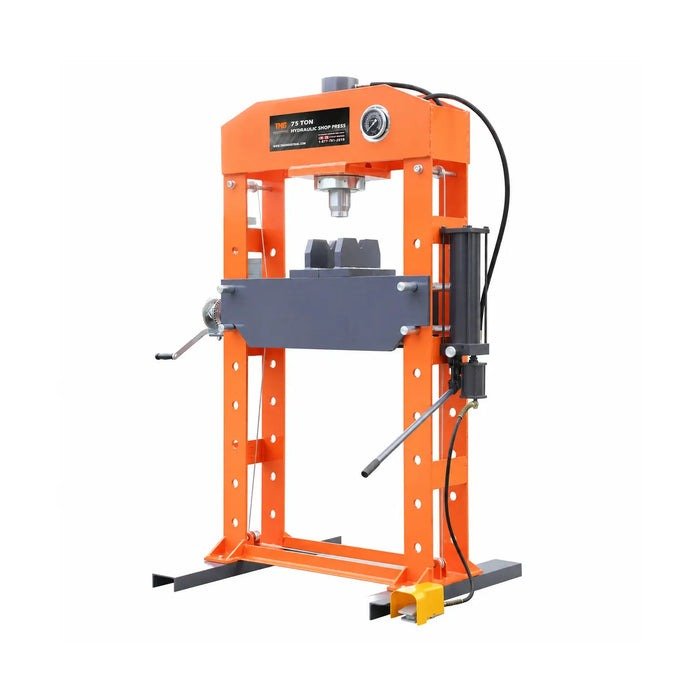
When the weather turns cold, many people move their projects into the garage, and a few jobs call for far more force than any hand tool can supply. A hydraulic shop press is built for those jobs: pressing bearings onto shafts, straightening bent parts, and pushing bushings in or out. Knowing how it creates its force, and how to use it safely, makes the tool far more useful and far less risky.
Pascal’s Principle in a Garage
A hydraulic press works on a simple rule of fluids. Pressure applied to oil in a closed system spreads equally in every direction. A small pump piston pushes oil into a larger cylinder, and the larger piston area turns that pressure into a much larger force. The trade-off is distance: the pump must make many strokes for the ram to move a short way. A bottle jack works the same way, and a shop press is that idea built into a heavy frame.
The H-Frame and Why It Matters
Most shop presses follow an H frame press design, built from two vertical columns joined by horizontal beams, which gives the machine its shape and its strength. Because the force pushes against the frame, the frame must be rigid and welded well. An H frame press has an adjustable bed that moves up and down on pins, so parts of different heights fit between the bed and the ram. Always insert the bed pins fully and keep the bed level.
Pump, Gauge, and Ram
A handle or an air-powered pump moves the oil. Many presses accept both, and an air over hydraulic press speeds up repeated work, while the manual option still works when no air is available. An air over hydraulic press suits a busy shop. A gauge shows the pressure so the operator can see how much force is being applied. The ram is the moving piston that touches the work, and it should move smoothly without side movement.
Choosing Press Plates and Supports
Parts should rest on solid supports that spread the load, and press plates and V-blocks help. Place the workpiece centered under the ram so force goes straight down, because an off-center load can slip and fly out. Use the correct adapters for bearings and bushings so force goes through the right surface, not the delicate part.
Common Jobs
A bearing press is among the most common uses, pushing a bearing into a housing or onto a shaft without hammering. Other jobs include pressing out worn bushings, straightening small bent parts, and assembling pulleys. A hydraulic shop press suits an automotive garage, a workshop, and a farm shop, where heavy parts are routine.
Safety First
A press stores a lot of force, so a few rules apply every time:
- Wear a face shield and safety glasses
- Never exceed the press’s rated capacity
- Keep hands clear of the work area
- Use a guard when pressing brittle parts
Parts can crack or shoot out under load, and a steel shield or a heavy blanket over the work adds protection. Stand to the side of the ram rather than directly in front, and stop immediately if the part shifts or makes an unusual sound.
Pressing a Bearing Step by Step
Pressing a bearing in follows a simple routine. Clean the housing and the bearing seat, and apply a light film of oil so the bearing slides rather than scrapes. Support the housing on blocks, set the bearing square, and place an adapter that touches only the outer ring when pressing into a housing, or the inner ring when pressing onto a shaft. Pump slowly, watch the gauge, and stop when the bearing seats, because extra pressure can crush it.
Straightening and Bending Safely
A press can straighten small bent parts, but the work needs care. Support the part at two points a distance apart and apply force between them, slowly, checking the shape often. Metal springs back, so a small overbend is usually needed. Heavy or hardened parts can snap rather than bend, so use a guard and keep everyone clear.
When Not to Use a Press
A press is not a hammer, and some jobs belong to other tools. Do not press anything that has been heated to soften it unless the work is planned and safe, do not press sealed or pressurized parts, and do not use the machine above its rated capacity. If a part will not move with reasonable force, stop and find out why, because heat, rust, or a hidden fastener may be holding it.
Mounting and Setup
Bolt the H frame press to the floor if it is meant to be anchored, and keep the floor level. An air over hydraulic press also needs a clean, dry air supply with a moisture trap, because water in the line can corrode the pump. Check that the frame has no cracks, the pins are straight, and the gauge reads zero at rest.
Checking Oil, Ram, and Fittings
Check the oil level and look for leaks around the ram and fittings. Wipe the ram clean, and lubricate the sliding parts of the bed. A hydraulic shop press that is kept clean, correctly loaded, and checked each season can serve a workshop for decades.
READ ALSO: Why Is Compound Identification Important in KLOW Peptide Research?